


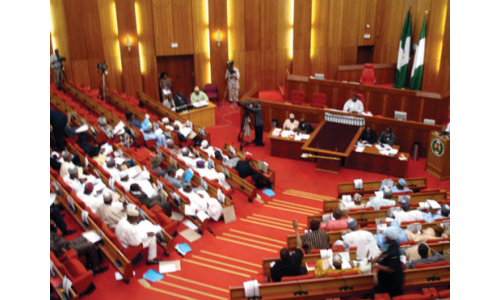

The Senate on Wednesday rejected budgetary proposal of N360 billion of Service Wide Vote in the N4.3 trillion 2015 Budget by the executive.
This was just as Upper chamber recommended that the practice should be eliminated from the nation’s budgeting system.
Some senators who spoke against Service Wide votes argued that the provision is a conduit pipe being used by the executive since the era of former President Olusegun Obasanjo to siphon money from the national purse.
Service Wide Vote is a major component of the Federal Government’s Ministries, Departments and Agencies budgets earmarked for contingencies and approved by the National Assembly but without projects attached to it.
However, the Upper Chamber with the adoption of the report of its Joint Committee on Finance, National Planning, Economic Affairs and Poverty Alleviation that worked on the Revised 2015-2017 Medium Term Expenditure Framework paper forwarded to the National Assembly in December last year by President Goodluck Jonathan, asked the executive to discontinue with the service wide votes, which was to gulp N360 billion in the 2015 budget if it had been approved.
In the report presented by the Chairman of the Senate Committee on Finance, Senator Ahmad Makarfi, N63 billion earlier earmarked under the vote for Presidential Amnesty Programme was pushed to the Ministry of Niger Delta.
The Joint Committee recommended that the N22 billion provision made under the vote for internal operations of the Armed Forces be transferred to the budget votes of the Ministry of Defence, just as all sums under the votes provided as arrears of pension and gratuity, are recommended for reclassification under relevant heads.
The Committee in its recommendations, which were adopted by Red Chamber, also made drastic cuts on the Subsidy Reinvestment and Empowerment Programme.
It was reviewed downward from N102.50 billion to N21.03 billion.
Also revised downward was the subsidy for Premium Motor Spirit, otherwise known as petrol, from N200 billion to N100 billion, with the projected subsidy sum on Kerosene also brought down from N91.08 billion to N45.52 billion.
Similarly the entire recurrent expenditure profile of the N4.3 trillion 2015 budget was also reduced from N2,616.01 trillion to N2,584.08 trillion, just as the Total Statutory Transfers sums were reduced from N411.85 billion to N363.27billion.
However, the total capital expenditure earlier proposed in the budget was increased from N633.53 billion to N700.78 billion, just as the total non-oil revenue was increased from N3,539.07 trillion to N4,024.11 trillion.
Other critical highlights of the adopted report are the new parameters fixed for the entire budget profile such as the $52 per barrel as oil price benchmark as against $65 per barrel proposed by the executive; exchange rate of N190 to a US dollar as against N160 to a US dollar proposed by the executive.
But the crude oil production of 2,327.1 million barrel per day was sustained along with that of 2016 projected to be 2,406.7 million barrel per day.
Follow The Eagle Online Channel on WhatsApp
[wpadcenter_ad id='745970' align='none']
