


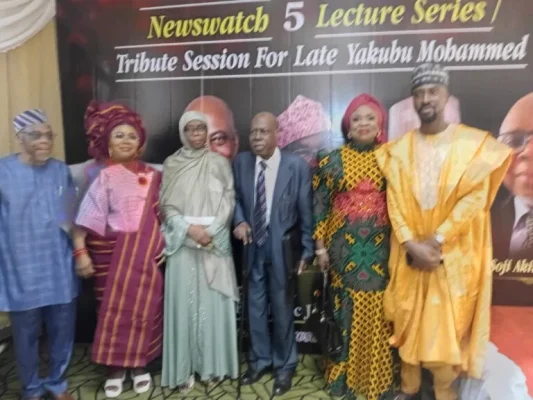

Veteran journalist Ray Ekpu has called for synergy between citizen journalism and traditional media to strengthen credibility and speed in information dissemination.
He spoke in Lagos at the unveiling of the Newswatch 5 Lecture Series/Tribute Session for late veteran journalist Yakubu Mohammed.
The event was held on Thursday in Lagos.
Mohammed, one of the founders of Newswatch magazine, died on January 13, 2026.


The Newswatch 5 are late Dele Giwa, late Dan Agbese, late Yakubu Mohammed, Ekpu, and Soji Akinrinade.
The event was organised by the Olori Janet Afolabi Foundation.
Janet Afolabi, wife of the Alapomu of Apomu in Osun State, Oba Kayode Afolabi, was a former staff of Newswatch.
Ekpu highlighted challenges posed by the evolving communication ecosystem.
He said the rise of citizen journalism, which was driven by widespread access to digital tools, had transformed ordinary individuals into active participants in news gathering and dissemination.
According to him, while this development has amplified voices and expanded access to information, it has also introduced concerns about accuracy, professionalism, and ethical standards.
- Reps seat: Aspirants reject APC consensus candidate in Ondo
- May Day: Obi hails workers, urges wage review, economic reforms
- May Day: Atiku blasts Tinubu-led government over Nigerian workers’ plight
- May Day: Nigerian workers backbone of national progress – Oluremi Tinubu
- Voter apathy rising geometrically in Nigeria, says Chidoka
He noted that untrained individuals often disseminated unverified information, sometimes mixing facts with falsehoods, thereby undermining public trust in news content.
“Some circulate unverified reports tagged ‘breaking news’ or ‘forwarded as received’, even when such information is misleading or completely false,” he said.
Ekpu, however, acknowledged that citizen journalism had come to stay and played a significant role in shaping modern communication and public discourse.
He proposed a “marriage of convenience” between citizen journalism and traditional journalism to harness the strengths of both systems.
He said that such “marriage” would combine the speed of citizen reporting with the credibility, verification processes, and ethical standards of professional journalism.
“The union should produce two outcomes – credibility and speed – ensuring that society benefits from timely and accurate information,” he said.
Ekpu emphasised that professional journalism remained a structured practice guided by ethical codes, editorial processes, and collaborative workflows, unlike individual-driven citizen reporting.
He urged media professionals to adapt to the changing landscape by engaging citizen contributors while maintaining rigorous standards of verification and accountability.
He said the legacy of Mohammed, known for accuracy and clarity, would offer a model for integrating innovation with professionalism in journalism practice.
He said Mohammed’s commitment to truth and ethical reporting underscored the need to preserve credibility amid rapid technological and societal changes.
Ekpu stressed that collaboration, rather than competition, between both forms of journalism would be essential for strengthening democracy and informed public engagement.
A former Vice-Chancellor of Ahmadu Bello University (ABU), Prof. Shehu Abdullahi, described Mohammed as a principled administrator and an accomplished journalist.
Abdullahi said that Mohammed lived a fulfilled life and left behind a strong family.
He recalled Mohammed’s tenure as Pro-Chancellor and Chairman of Council at ABU, where he introduced reforms, promoted transparency, and boosted staff morale.
“He upheld integrity and resisted selfish interests, ensuring the university’s progress,” he said.
Also, the Head of Mass Communication Department, University of Lagos, Prof. Ibitayo Popoola, described Mohammed as a key figure in journalism.
Popoola said that Mohammed’s contributions to the media industry and academia would endure.
He prayed for the repose of his soul, and urged journalists to uphold his legacy of excellence.
