


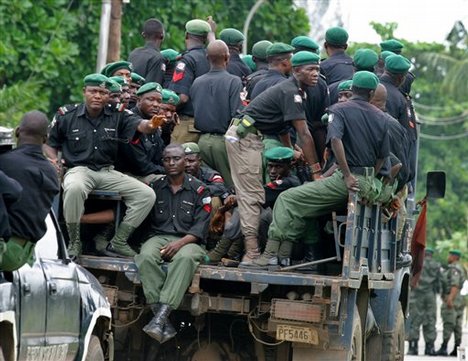

The Nigeria Police Force in one fell swoop lost 49 of its officers. The State Security Service (SSS) also lost 10 men on the same day.
The officers, who were on their way to Alakyo village, Nasarawa State, to confront the Ombatse cult, were ambushed and killed.
However, the incident, which forced President Goodluck Jonathan to cut short his visit abroad, did not dampen the morale of the police and SSS.
Reacting to the killings, the Inspector-General of Police, Mr Mohammed Abubakar, vowed that nobody or group of persons operating under any name would kill police officers and get away scot-free.
“We cannot keep quiet to allow anybody in this country, whether individuals or group of persons, under whatever name they call themselves, to kill officers of the police force and go scot-free,’’ he yelled.
Also speaking, Mr Ekpenyong Ita, the Director-General of the SSS, declared said that in spite of the officers’ killing, the service would not be cowed or intimidated by the incident.
He vowed that the SSS would remain resolute, determined and even more focused.
“For the sake of our colleagues and the survival of our country, we will never raise the white flag. It is those who do not wish this country well that must succumb,’’ he said.
The I-G, at a meeting with Assistant-Inspectors General of Police in charge of the 12 zonal police commands across the nation on Aug. 1, charged them to redouble their efforts in combating crime.
“I urge you to pay more attention to the rising crime wave across the country; daily situation reports bear testimony to this phenomenon.
“In spite of the emergency rule in Adawawa, Borno and Yobe, the insurgents still inflict untold hardship on peace-loving residents of these states.
“In the South-East and South-South geopolitical zones, armed robbery, kidnapping and other violent crimes such as murder and assassination seem to be the order of the day.
“Hardly does a day pass by without one hearing tales of woes: of residents being robbed or kidnapped, of assassination of political rivals.
“I, therefore, charge you to sit up and tackle these menaces, while ensuring that the ordinary citizens get reprieve from those hell-bent on inflicting anguish and pain on them,’’ he said.
Experts call for a sustained approach to tackle the myriad security challenges facing the country, but they, nonetheless, bemoan the presence of military personnel in the states.
They note that nowadays, there is a heavy military presence in 28 states, under the aegis of various joint task forces.
Prof. Isawa Eliagwu, the President of Institute of Governance and Social Research, Jos, underscored the need to place less emphasis of the involvement of the military in the management of the country’s internal crises.
Eliagwu made the remark, while delivering the 2013 Annual October Lecture of the Federal Radio Corporation of Nigeria (FRCN).
“The truth is that the number of soldiers on the streets since May 1999 has not been there even during the civil war between 1967 and 1971.
“Virtually in every state, there are soldiers deployed; in the Niger Delta area, they were there for about 15 years; in 28 states, you have Joint Task Forces (JTFs).
“It is wrong for a democracy to be a military tentacle; the soldiers are supposed to help in putting down civil disobedience and then go back to the barracks,’’ he said.
Eliagwu stressed that the police, who were particularly trained to deal with internal security challenges, were inadequately equipped, irregularly trained and under-funded to confront crises.
He, however, called for the creation of an early warning system, with appropriate response mechanism and conflict-management units in all the local government areas of the country.
“There should be conflict-management units in every local government and every state, to easily prevent problems,’’ he said, adding that prevention was one of the best conflict-management techniques.
A former Head of State, Gen. Abdulsalami Abubakar, advocated the active involvement of the civil populace in efforts to tackle the current security challenges facing the country.
He also called for the establishment of a comprehensive National Security Strategy and Joint Information Centre in the country.
The ex-head of state made the recommendations in a lecture — “A Comprehensive Approach to National Security Management in Nigeria’’ — which he delivered at the National Defence College, Abuja, on Oct. 7.
Abubakar noted that the nature and pattern of new and emerging security threats in Nigeria indicated that security could no longer be achieved via absolute reliance on security agencies alone.
“These threats show that the attainment and preservation of the country’s security should and must be everybody’s business.
“The entire citizens should be involved, as security is everybody’s business, and all of us are equal stakeholders,’’ he added.
By Johnson Eyiangho, News Agency of Nigeria (NAN)
