


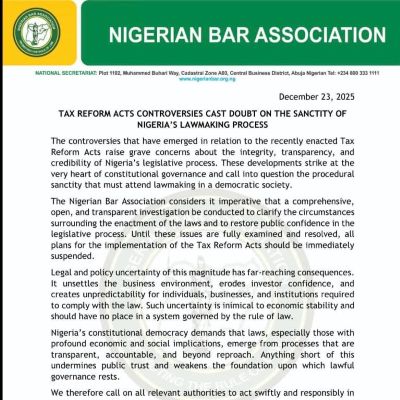

The Nigerian Bar Association has asked the Federal Government to halt implementation of the Tax Reforms Act which is billed to start on January 1, 2026 pending the conclusion of investigation on controversies around the Act.
The demand was made by the NBA National President, Afam Osigwa in a statement issued on Tuesday.
The association further demanded for open and comprehensive investigation be conducted to clarify the circumstances surrounding the enactment of the laws and to restore public confidence in the legislative process.
NBA said that Nigeria’s institutional democracy requested that laws, especially those with profound economic and social implications, emerge from processes that are transparent, accountable, and beyond reproach.


He added that anything short of transparency in the lawmaking undermines public trust and weakens the foundation upon which lawful governance rests.
The statement reads, “The controversies that have emerged in relation to the recently enacted Tax Reform Acts raise grave concerns about the integrity, transparency, and credibility of Nigeria’s legislative process. These developments strike at the very heart of constitutional governance and call into question the procedural sanctity that must attend lawmaking in a democratic society.
Also Read:
- 2027: Kwankwaso will run as Peter Obi’s deputy — Kwankwasiyya
- Peter Obi and the cross of a Nation, by Valentine Obienyem
- First Lady flags off 2026 planting season in Niger
- David Ogbueli and unseen architecture of global transformation, by Blaise Udunze
- 2027: Wike’s ally joins presidential race, picks PDP forms
“The Nigerian Bar Association considers it imperative that a comprehensive, open, and transparent investigation be conducted to clarify the circumstances surrounding the enactment of the laws and to restore public confidence in the legislative process. Until these issues are fully examined and resolved, all plans for the implementation of the Tax Reform Acts should be immediately suspended.
“Legal and policy uncertainty of this magnitude has far-reaching consequences. It unsettles the business environment, erodes investor confidence, and creates unpredictability for individuals, businesses, and institutions required to comply with the law. Such uncertainty is inimical to economic stability and should have no place in a system governed by the rule of law.
“Nigeria’s constitutional democracy demands that laws, especially those with profound economic and social implications, emerge from processes that are transparent, accountable, and beyond reproach. Anything short of this undermines public trust and weakens the foundation upon which lawful governance rests.
“We therefore call on all relevant authorities to act swiftly and responsibly in addressing this controversy, in the overriding interest of constitutional order, economic stability, and the preservation of the rule of law.”
