


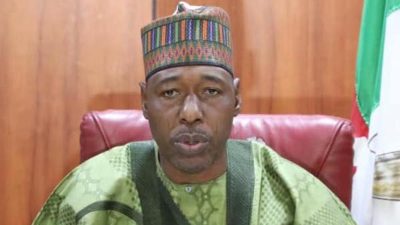

Governor Babagana Zulum of Borno State on Monday said the Boko Haram conflict was not a religious crisis as portrayed by some group.
The governor stated this while addressing the leaders of Muslim and Christian faith in the state, where he called for reconciliation and harmony among the diverse people of the state.
Zulum said: “The Boko Haram conflict is not a religious crisis.
“It is an assault on our civilisation, humanity, and all that we hold dear, irrespective of creed.


“It is absolutely crucial that we collectively dispel all false narratives that seek to portray our security crisis in a religious colouration.
“Religious conflict is alien to us.
“The perpetrators of violence have killed, maimed, and displaced Muslims and Christians alike.
“They have destroyed Mosques and Churches with equal impunity.”
According to the governor, the statistics of victimhood are stark and heart-breaking.
He said: “While every single life lost is regrettable, the data clearly shows that the overwhelming majority of those who have suffered death, abduction, and displacements are our Muslim brothers and sisters.”
He said the tragedy should bind the people of Borno State in a common grief and solidarity for a united response.
Zulum said his administration’s reconstruction, resettlement, and rehabilitation programmes are guided by principles of justice, equity, and inclusivity.
“We rebuild based on need and on our commitment towards restoring the social fabric of every community,” the governor said.
He said his administration had reconstructed 45 Christian worship centres that were destroyed during the Boko Haram insurgency.
Also Read
- Diplomacy is not a joyride: The argument against ignorance, by Uche Nnadozie
- NYSC approves passing-out date for Batch ‘A’ Stream II corps members
- Nasarawa: Rep quits governorship race, declares for senate
- Singer Skales claims footballers earn more than musicians, offers reason + Video
- FG moves to avert pension crisis, orders mass compliance
He said: “This number includes 16 from Hawul, 11 from Gwoza, 10 from Askira-Uba and 8 from Chibok.
“We did not do all these as a favour; we did it as a duty. Just as we have rebuilt countless mosques, markets, schools, and homes.”
Zulum urged religious leaders to continue to champion interfaith harmony, denouncing violence, and fostering reconciliation in the state.
He stated that the purpose of calling them was for him to address a fundamental pillar that would shape the future of the peaceful coexistence between Muslim and Christian communities in the state.
He further urged the international community to partner with the state in addressing the underlying causes of the insurgency, which he said was not limited to endemic poverty, illiteracy and hunger, among others.
Responding, the State Chairman of the Christian Association of Nigeria (CAN), Bishop John Bakeni, and his counterpart of Jama atu Nasril Islam (JNI), Sheikh Jafar Ngamdu, promised to take his message of peace to the people.
